Here’s a secret that Korea’s tourism board won’t tell you: Korea can be incredibly cheap. Or it can drain your wallet in 48 hours. The difference comes down to knowing where to spend and where to save.
I’ve lived in Seoul for over 35 years and I’ve helped dozens of friends and family members plan budget trips here. The sweet spot? Around ₩60,000–₩80,000 per day (roughly $45–$60 USD) gets you a comfortable, fulfilling trip without feeling like you’re constantly cutting corners.
This guide breaks down exactly how to do it — from accommodation and food to transportation and free activities. No vague tips. Real numbers, real places, real strategies.
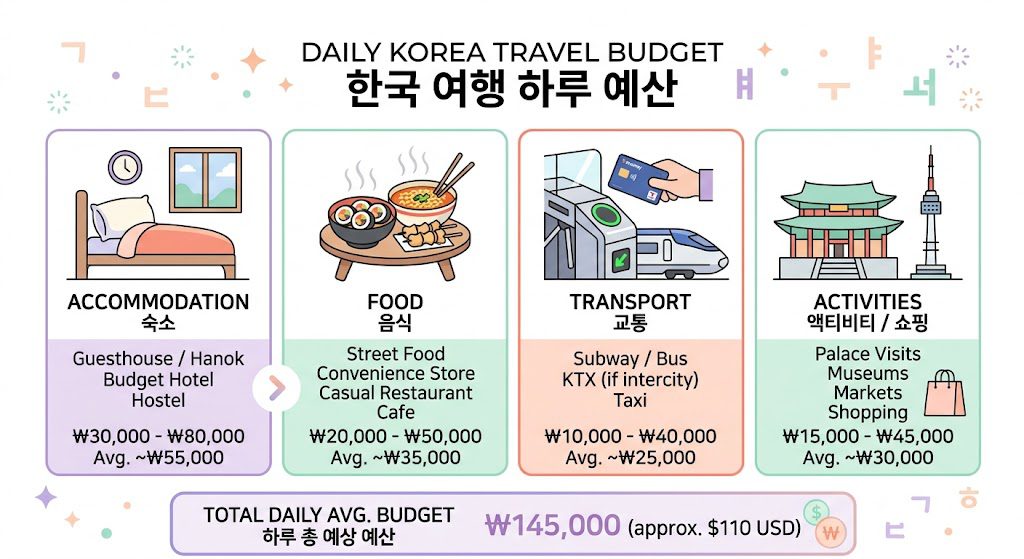
Daily Budget Breakdown: What Korea Actually Costs
A realistic daily budget for Korea in 2026
Here’s a realistic daily budget for a budget traveler in Korea (2026 prices):
Category
Budget
Mid-Range
Comfortable
Accommodation
₩15,000–₩25,000
₩40,000–₩70,000
₩80,000–₩150,000
Food
₩15,000–₩25,000
₩30,000–₩50,000
₩50,000–₩80,000
Transportation
₩5,000–₩8,000
₩8,000–₩15,000
₩15,000–₩30,000
Activities
₩0–₩10,000
₩10,000–₩30,000
₩30,000–₩60,000
Daily Total
₩35,000–₩68,000
₩88,000–₩165,000
₩175,000–₩320,000
Yes, you read that right. You can survive in Korea on ₩35,000 a day if you’re really disciplined. But ₩60,000–₩80,000 gives you a much more enjoyable experience without the constant penny-pinching.
Cheap Accommodation in Korea
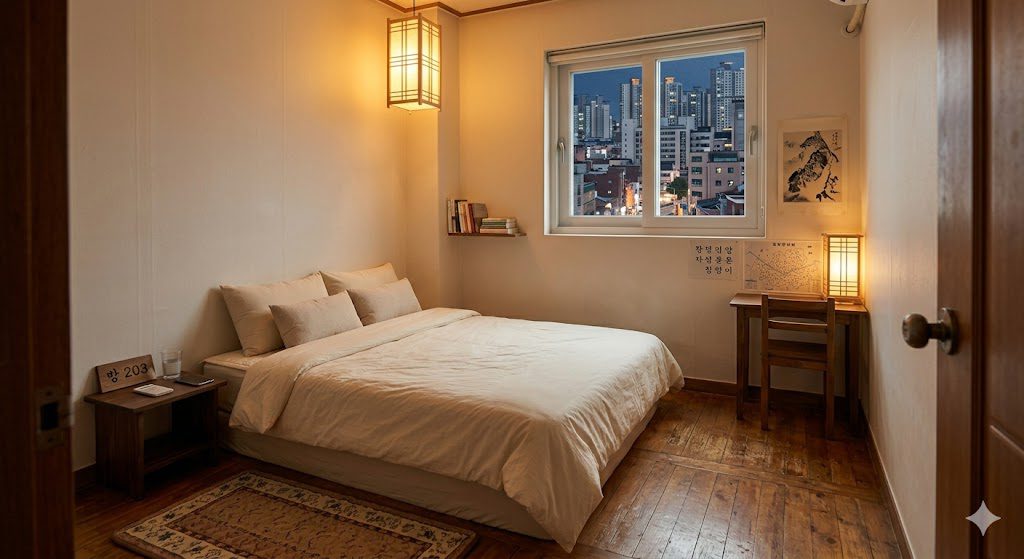
Budget guesthouses in Korea are clean and comfortable
Accommodation is your biggest expense — and where you have the most room to save.
Guesthouses and Hostels (₩15,000–₩30,000/night)
Korea has excellent guesthouses, especially in Seoul. Most include free Wi-Fi, clean shared bathrooms, and sometimes free breakfast. Hongdae and Myeongdong have the highest concentration of budget hostels.
Dorm bed: ₩15,000–₩20,000/night
Private room: ₩25,000–₩40,000/night
Where to book: Booking.com, Hostelworld, or Naver (for Korean-listed guesthouses with better prices)
Jjimjilbang — The ₩12,000 Hotel (₩9,000–₩15,000/night)
This is the ultimate budget hack. A jjimjilbang (Korean spa) gives you a warm sleeping spot, hot baths, sauna rooms, and even a uniform — all for under ₩15,000. It’s not luxurious, but it’s safe, warm, and an experience in itself.
Best budget jjimjilbang: Siloam Sauna near Seoul Station (₩9,000 daytime / ₩12,000 overnight).
Airbnb and Goshiwon (₩20,000–₩40,000/night)
Goshiwon (고시원) are tiny single rooms originally designed for students. They’re bare-bones — just a bed, desk, and shared bathroom — but they’re cheap and private. Prices start at ₩15,000/night for daily stays.
Airbnb can be a great deal if you’re traveling with friends and splitting a whole apartment. A 2-bedroom in Hongdae runs ₩60,000–₩80,000/night — split that 3 ways and it’s cheaper than a hostel.
Accommodation Pro Tips
Book at least 2 weeks ahead for the best prices, especially during peak season (April cherry blossoms, October foliage).
Stay near subway stations. Seoul’s subway is so efficient that location matters less than proximity to a station. A cheaper room 2 stations away beats an expensive one in the center.
Consider staying outside Seoul. Places like Suwon or Incheon have much cheaper accommodation and are under 1 hour from central Seoul by subway.
Eating Cheap in Korea
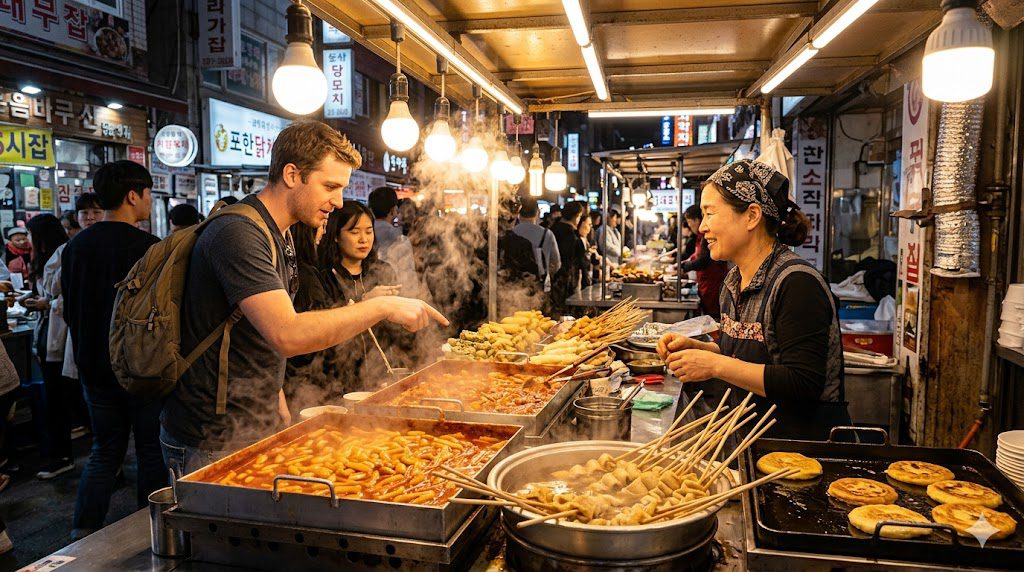
Korean street food: delicious meals for under 5000 won
This is the best part of budget travel in Korea: the cheap food is actually delicious. You’re not sacrificing quality — you’re eating exactly what locals eat every day.
Street Food (₩1,000–₩5,000 per item)
Korean street food is legendary, and it’s absurdly cheap:
Tteokbokki (spicy rice cakes) — ₩3,000–₩4,000
Odeng/Eomuk (fish cake skewers) — ₩1,000 per skewer
Hotteok (sweet stuffed pancake) — ₩1,500–₩2,000
Kimbap (Korean rice rolls) — ₩2,500–₩3,500
Mandu (dumplings) — ₩3,000–₩4,000
A full street food meal costs ₩5,000–₩8,000. That’s less than $5 USD for an incredible amount of food.
Convenience Store Meals (₩2,000–₩5,000)
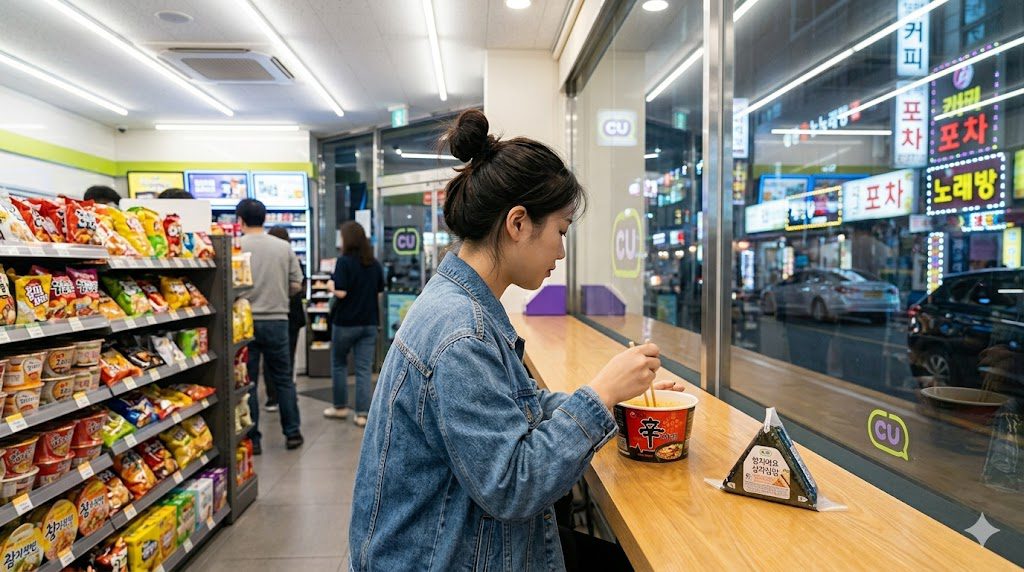
Convenience store meals: budget travelers best friend
Korean convenience stores (CU, GS25, 7-Eleven) are a budget traveler’s best friend. These aren’t your typical gas station stores — they have legitimately good food:
Triangle kimbap — ₩1,200–₩1,800
Cup ramyeon — ₩1,200–₩2,000 (hot water dispensers are free)
Dosirak (lunch box) — ₩3,500–₩5,000 (full meals with rice, meat, and sides)
Banana milk — ₩1,500 (the iconic Korean drink)
A convenience store breakfast + lunch combo runs about ₩5,000–₩8,000 total. Save your money for a proper Korean dinner.
Local Restaurants (₩6,000–₩12,000 per meal)
Eat where Koreans eat. Look for restaurants near office buildings during lunch — they serve 백반 (baekban), a set meal with rice, soup, and 3–5 side dishes, for ₩7,000–₩9,000. It’s a full, balanced, home-style Korean meal.
All of these come with unlimited free side dishes (반찬, banchan). Yes, free. And yes, you can ask for refills.
Food Saving Tips
Eat your big meal at lunch. Many restaurants offer cheaper lunch specials (점심특선) that are identical to dinner portions.
Markets are cheaper than restaurants. Gwangjang Market and Namdaemun Market have incredible food at street-food prices.
Cook at your Airbnb. Korean supermarkets (E-Mart, Homeplus) have amazing prepared foods and meal kits for ₩3,000–₩7,000.
Drink at convenience stores. A beer at a bar costs ₩5,000–₩8,000. A can from CU costs ₩2,500. Soju is ₩1,800 everywhere.
Getting Around on a Budget
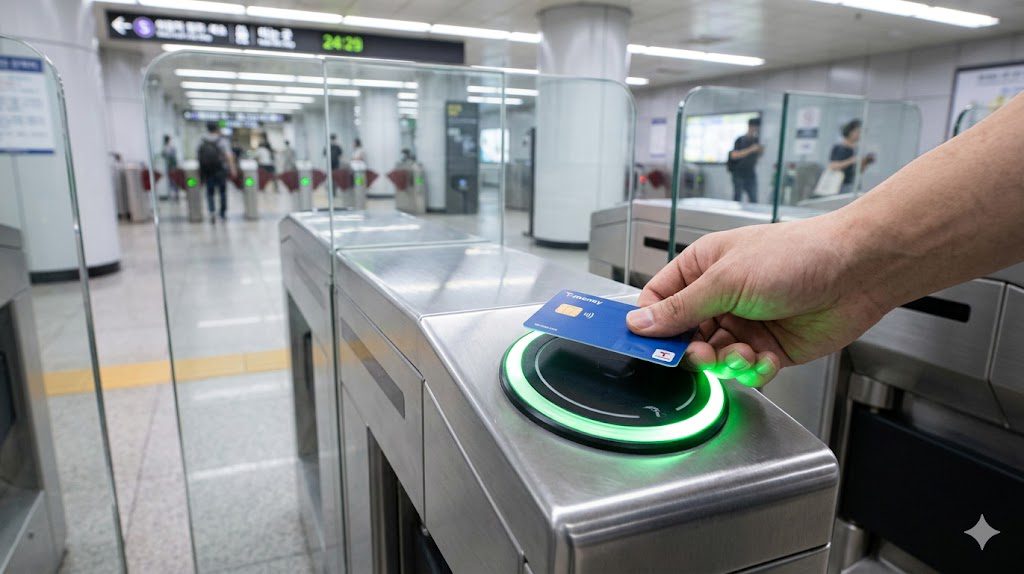
T-money card saves you money on every ride
Seoul has one of the best public transportation systems in the world — and it’s incredibly cheap.
T-money Card — Your Best Friend
Get a T-money card immediately. It works on all subways, buses, and even taxis. Benefits:
Subway ride: ₩1,400 (vs ₩1,500 with a single-use ticket)
Bus ride: ₩1,200
Free transfers between subway and bus within 30 minutes
Where to buy: Any convenience store. ₩2,500 for the card + whatever you want to load.
Seoul Subway — The Star of the Show
The Seoul subway covers virtually everywhere you’d want to go as a tourist. It’s clean, safe, on time, and runs from about 5:30 AM to midnight. Most rides within central Seoul cost ₩1,400–₩1,600.
KTX and Intercity Travel
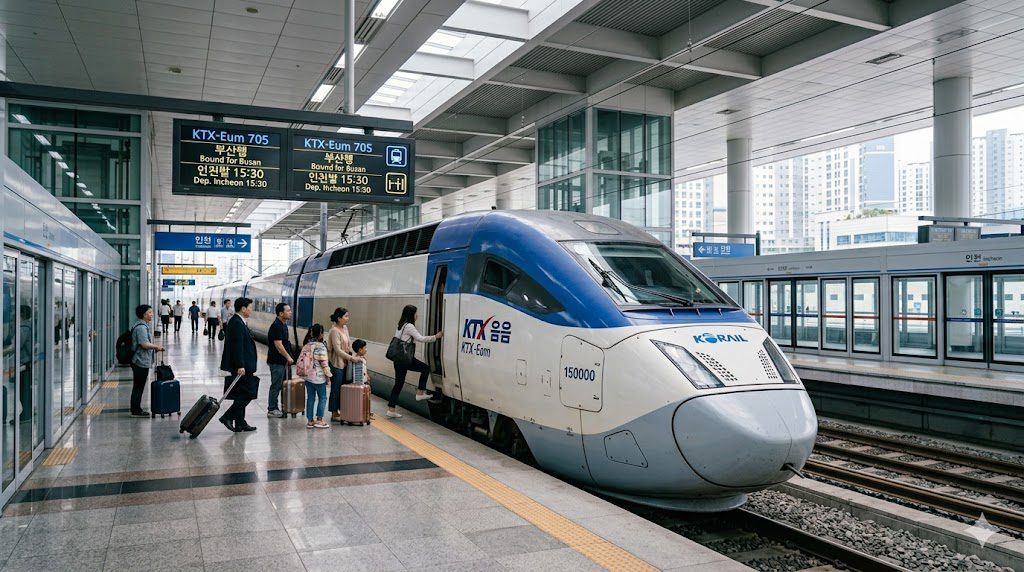
KTX: fast but consider slower trains to save money
Traveling beyond Seoul? Here’s how to save:
KTX (high-speed train) to Busan: ₩59,800 regular. Book early on the Korail app for occasional discounts.
Mugunghwa (slow train) to Busan: ₩28,600 — takes 5 hours instead of 2.5, but nearly half the price.
Express buses: Often 30–50% cheaper than KTX. Seoul to Busan by bus is around ₩23,000–₩35,000. Book at the terminal or via the “고속버스” app.
Korea Rail Pass: If you’re visiting 3+ cities, the Korail Pass (₩121,000 for 3 days) can save significant money.
Transportation Tips
Never take taxis during rush hour. Seoul traffic doubles the meter. Subway is always faster from 7–9 AM and 5–8 PM.
Walk more than you think. Many of Seoul’s best neighborhoods (Hongdae, Itaewon, Bukchon) are best explored on foot.
Late night? After midnight when subways close, take a night bus (₩2,300) instead of a taxi (₩15,000+).
Free and Cheap Things to Do
Korea has an insane amount of free activities. You could honestly fill an entire week without paying for a single attraction.
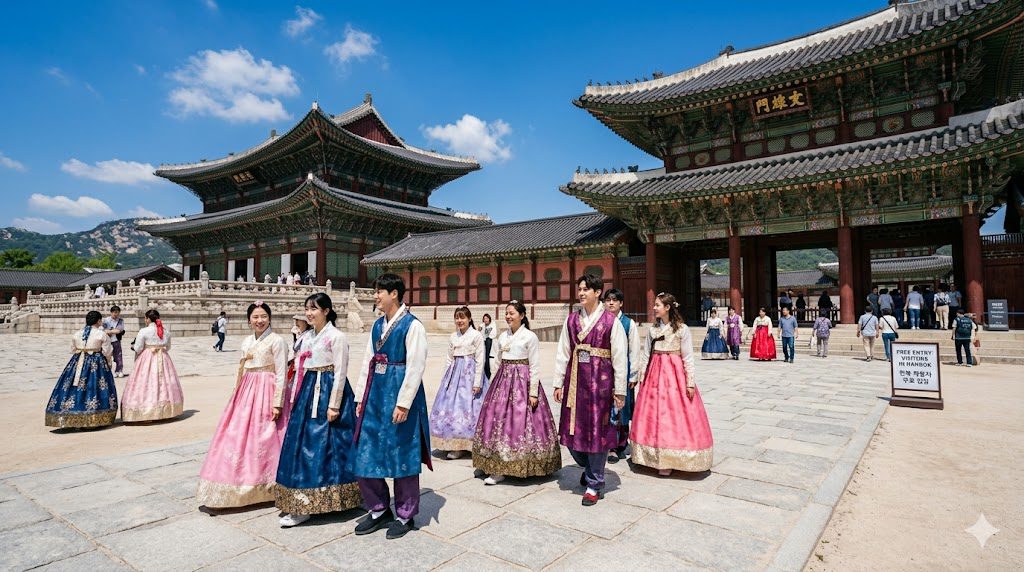
Wear hanbok for free palace entry
Completely Free
Palaces in hanbok — Rent a hanbok (traditional clothing) for ₩10,000–₩15,000 and get free entry to Gyeongbokgung, Changdeokgung, and all major palaces. Without hanbok, entry is only ₩3,000 anyway.
Namsan Seoul Tower hike — The hike up Namsan is free and offers incredible city views. Only the observatory tower costs money (₩16,000).
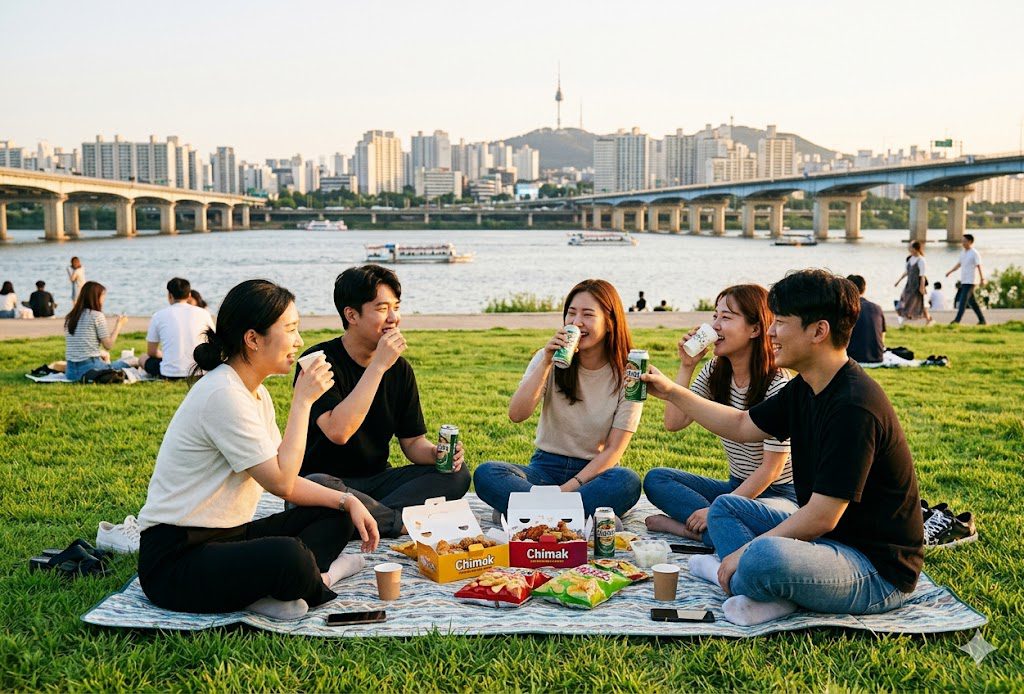
Han River parks — Rent a mat (or bring a blanket), order delivery chicken, and enjoy the most Korean experience possible.
Cheonggyecheon Stream — A beautiful urban stream walk through downtown Seoul.
Temple stays (day programs) — Some temples offer free meditation and tea ceremonies.
Hongdae street performances — Free live music, dance, and art every weekend evening.
National museums — The National Museum of Korea and National Folk Museum are free. Both are excellent.
Han River picnic: the most Korean experience possible
Under ₩10,000
Korean cooking class (budget) — Some community centers offer classes for ₩5,000–₩10,000.
Jjimjilbang visit — ₩9,000–₩12,000 for hours of sauna, bathing, and relaxation.
Photo booths — Korea’s photo booth culture is fun and cheap at ₩4,000–₩6,000.
PC방 (PC rooms) — Gaming cafes for ₩1,000–₩1,500/hour. Great for rainy days.
노래방 (Karaoke) — ₩5,000–₩10,000 per hour for a private room.
Money-Saving Hacks Only Locals Know
These are the tips that don’t make it into most travel guides:
Use Korean apps for deals.Coupang Eats and Baemin (배달의민족) regularly offer ₩3,000–₩5,000 discount coupons for first-time users. Free delivery too.
Visit the “last chance” bakeries. Paris Baguette and Tous les Jours discount bread and pastries by 30–50% after 8 PM. A ₩5,000 bag of fresh bread and pastries makes a great breakfast.
Free water everywhere. Every Korean restaurant provides free water (and free side dishes). You never need to buy bottled water at a restaurant.
Charge your phone for free. Almost every cafe, convenience store, and subway station has charging stations. No need for a portable battery.
Get the Discover Seoul Pass. If you plan to visit 3+ paid attractions, the Discover Seoul Pass (₩39,900 for 24 hours) includes free entry to 30+ attractions plus discounts on more.
Exchange money at Myeongdong. The private money changers in Myeongdong give significantly better rates than airports or banks. Look for the small exchange booths on the main street.
Travel in shoulder season.March and November have great weather, fewer tourists, and lower prices across the board — flights, accommodation, and activities.
Sample 1-Day Budget Itinerary: Seoul for ₩65,000
Time
Activity
Cost
8:00 AM
Breakfast: Triangle kimbap + coffee from CU
₩3,500
9:00 AM
Subway to Gyeongbokgung Palace (free with hanbok rental)
₩1,400 + ₩12,000
11:30 AM
Walk through Bukchon Hanok Village
Free
12:30 PM
Lunch: Kimchi jjigae at a local restaurant
₩8,000
2:00 PM
Subway to Hongdae, explore shops and cafes
₩1,400
3:30 PM
Iced Americano at a Korean cafe
₩4,500
5:00 PM
Walk to Mangwon Market for street food dinner
₩8,000
7:00 PM
Subway to Han River, picnic with convenience store snacks + beer
₩6,000
9:30 PM
Back to guesthouse
₩1,400
—
Accommodation (hostel dorm)
₩18,000
TOTAL
₩64,200
A full, satisfying day in Seoul — palaces, hanbok, street food, cafe culture, Han River picnic — for under ₩65,000. And you didn’t miss a single thing.
Korea Budget Travel FAQ
Is Korea cheaper than Japan?
Generally yes. Food is significantly cheaper in Korea, accommodation is similar, and transportation is slightly cheaper. Overall, expect Korea to be 15–25% cheaper than Japan for a similar trip style.
How much cash should I bring?
Korea is largely cashless — credit cards and Samsung/Apple Pay work almost everywhere. Bring ₩100,000–₩200,000 in cash for small street food vendors and traditional markets. That’s it.
Is tipping expected?
No. Tipping is not customary in Korea — not at restaurants, not for taxi drivers, not at hotels. This alone saves you a significant amount compared to other countries.
Can I travel Korea for under ₩50,000/day?
Yes, if you sleep at jjimjilbangs, eat mostly street food and convenience store meals, and stick to free activities. It’s doable but tight. ₩60,000–₩80,000 is the sweet spot for comfort.
When is the cheapest time to visit?
January–February (cold, fewer tourists) and November (after foliage season). Flights and accommodation drop 20–40% compared to peak months (April, September–October).
Final Thoughts
Korea is one of the best value destinations in Asia. The food is cheap and incredible. Public transportation is world-class and affordable. Many of the best experiences — palaces, hiking, markets, street performances — are completely free.
The key is simple: eat where locals eat, take public transit, skip the tourist traps, and spend your money on experiences rather than fancy hotels. Do that, and you’ll have the trip of a lifetime without the credit card bill to regret afterward.