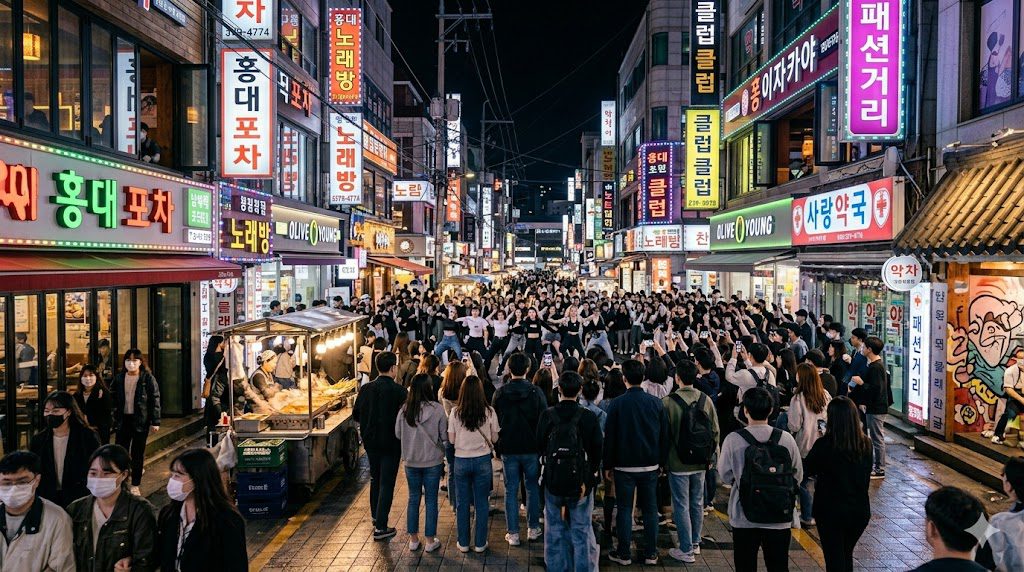
Seoul doesn’t sleep. That’s not a figure of speech — it’s literally a city that runs 24 hours a day, 7 days a week. And when the sun goes down, an entirely different Seoul comes alive.
I’ve spent 35 years navigating this city’s nightlife — from the gritty pojangmacha tents of my college days to the rooftop cocktail bars that now dot the Gangnam skyline. And I can tell you that Seoul’s after-dark scene is one of the most diverse, affordable, and exciting in Asia.
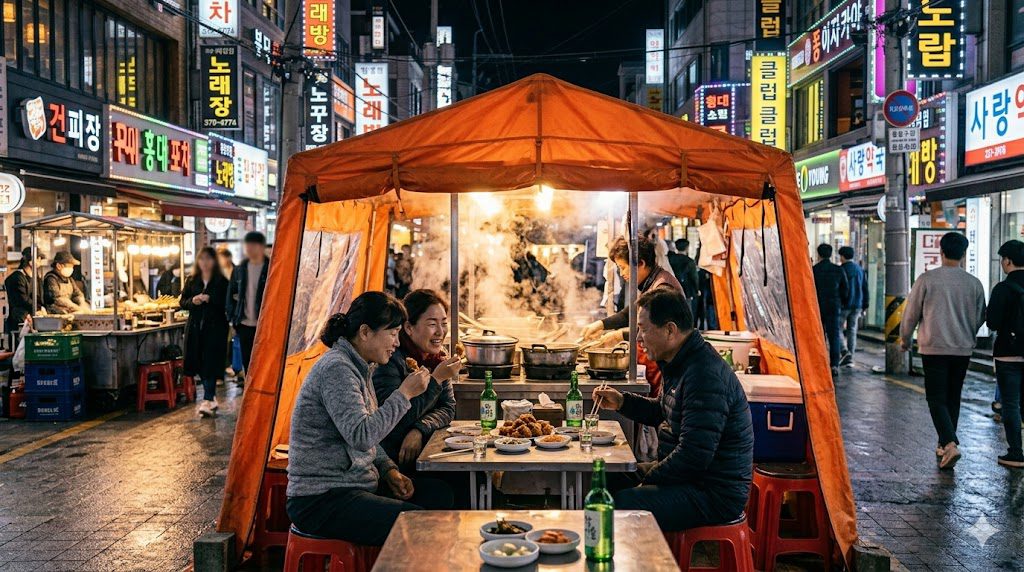
Whether you want to dance until 6 AM, sip craft cocktails above the city, or just eat fried chicken under an orange tent at 2 AM — this guide has you covered.
Understanding Korean Drinking Culture
Soju, beer, and somaek: the holy trinity of Korean drinking
Before diving into where to go, you need to understand how Koreans drink. Drinking culture here is deeply social and comes with its own unwritten rules.
The Basics
Soju (소주) is king. This clear rice spirit (16–20% ABV) is the most consumed alcohol in the world. A bottle costs ₩4,000–₩5,000 at a restaurant, ₩1,800 at a convenience store.
Beer (맥주) is the partner. Korean beers (Cass, Hite, Terra) are light lagers — fine but unremarkable. The craft beer scene, however, has exploded in recent years.
Somaek (소맥) is the ritual. A shot of soju dropped into a glass of beer. Koreans have an entire science around the perfect soju-to-beer ratio. You’ll be taught on your first night out.
Makgeolli (막걸리) is the wildcard. Milky rice wine, slightly sweet, and dangerously drinkable. Best enjoyed at traditional markets or pajeon (pancake) restaurants on rainy days.
Drinking Etiquette
Korean drinking has rules. Follow these and you’ll earn instant respect:
Never pour your own drink. Pour for others, and they’ll pour for you. This is the most important rule.
Use two hands when pouring for someone older or when receiving a drink from them. One hand on the bottle, one supporting your wrist or the bottom.
Turn away from elders when drinking. If someone older pours you a drink, turn your head slightly to the side before taking a sip. It’s a sign of respect.
Don’t refuse the first drink. Declining the first offered drink is considered rude. After that, you can pace yourself.
Say “건배!” (geonbae) — It means “cheers!” Clink glasses, make eye contact, and drink.
Seoul’s nightlife is spread across several distinct neighborhoods, each with its own personality. Here’s where to go based on what you’re looking for.
Hongdae (홍대) — The Energy Capital
Hongdae at night: Seoul undisputed nightlife hub
Best for: Clubs, live music, indie vibes, budget-friendly nights
Hongdae is Seoul’s undisputed nightlife hub. Named after Hongik University, this neighborhood is packed with college students, indie musicians, and an energy that doesn’t quit until sunrise.
What you’ll find:
Clubs: NB1, NB2, Cocoon, and m2 are the biggest. Cover charges range from ₩10,000–₩20,000, usually including one free drink.
Live music: Small venues like Rolling Hall and DGBD showcase Korea’s indie and rock scene. Tickets ₩10,000–₩20,000.
Bars: Hundreds of them. Everything from craft beer pubs to soju tents to themed cocktail bars.
Street performers: Free entertainment every Friday and Saturday night in the main playground area.
Itaewon: Seoul most international nightlife district
Best for: Expats, diverse crowd, LGBTQ+ scene, international food
Itaewon is Seoul’s most international neighborhood. Historically home to the US military base, it’s evolved into a multicultural hub where English is spoken everywhere and the bar scene caters to a global crowd.
What you’ll find:
Cocktail bars: Charles H (inside Four Seasons Hotel) consistently ranks among Asia’s best bars. Also try Southside Parlor and Cobbler for craft cocktails.
Craft beer: Magpie Brewing and Craftworks are Itaewon staples with excellent local brews.
LGBTQ+ scene: The Homo Hill area (near the Hamilton Hotel) has Seoul’s most established LGBTQ+ bar scene, with venues like Queen, Trance, and Pit-a-Pat.
Late-night food: International restaurants stay open until 3–4 AM. Perfect for post-bar meals.
Gangnam rooftop bars offer stunning Seoul skyline views
Best for: Rooftop bars, high-end clubs, impressive date nights
Gangnam is where Seoul’s money comes out to play. The nightlife here is polished, expensive, and unapologetically flashy.
What you’ll find:
Clubs: Arena, Octagon (previously ranked one of the world’s top clubs), and Burning Sun’s successors. Expect ₩20,000–₩30,000 cover charges, bottle service culture, and dress codes.
Rooftop bars: Seoul’s best skyline views. Try Floating in Cheongdam or Alice Cheongdam for stunning rooftop cocktails (₩15,000–₩25,000 per drink).
Wine bars: Apgujeong and Cheongdam have Seoul’s best wine bar scene.
Dress code: This matters in Gangnam. No shorts, no sandals. Business casual minimum for the nicer spots.
Jongno (종로) — The Traditional Side
Best for: Pojangmacha (tent bars), traditional drinking, local-only vibes
Jongno is where older Seoul drinks. The area around Jongno 3-ga is famous for its pojangmacha (포장마차) — orange tent bars lining the streets, serving soju, beer, and classic Korean drinking snacks.
What you’ll find:
Pojangmacha tents: Sit on plastic stools, order odeng (fish cakes), dubu kimchi (tofu with kimchi), and fried chicken. Soju is ₩4,000–₩5,000 per bottle.
Makgeolli bars: Traditional rice wine paired with pajeon (green onion pancake). A truly Korean experience.
Euljiro craft scene: The neighboring Euljiro area has become a hipster hotspot with hidden speakeasy-style bars tucked behind old print shops and industrial buildings.
Koreans don’t just “go to a bar.” A proper Korean night out follows a multi-round structure called 차 (cha). Each round is a different venue:
Round
Korean
What It Is
1차 (il-cha)
First round
Dinner + drinks at a restaurant. Korean BBQ, chicken, or jjigae with soju and beer.
2차 (i-cha)
Second round
Move to a bar, pub, or hof (Korean beer hall). More drinks, lighter snacks.
3차 (sam-cha)
Third round
Noraebang (karaoke), club, or late-night pojangmacha.
4차 (sa-cha)
Fourth round
해장 (haejang) — hangover soup at 4 AM. The sacred Korean tradition.
You don’t have to do all four rounds — but if you’re with Korean friends, expect at least 2차. And if someone suggests 3차 at a noraebang, always say yes.
Noraebang: Korea’s Karaoke Culture
Noraebang: no Korean night out is complete without it
No Korean night out is complete without noraebang (노래방), which literally means “singing room.” Unlike Western karaoke bars, Korean noraebangs give you a private room with your group — no singing in front of strangers.
What to know:
Price: ₩15,000–₩25,000 per hour for a room (split among your group).
Song selection: Thousands of Korean and English songs. K-pop, Western pop, classic rock — it’s all there.
Extras: Tambourines, maracas, and disco lights in every room. Some places have costumes.
Coin noraebang: Solo singing booths for ₩500–₩1,000 per song. Perfect if you’re alone and want to belt out some K-pop.
Even if you can’t sing, noraebang is an absolute blast. Pick an easy crowd-pleaser (Bohemian Rhapsody works everywhere) and commit. Nobody judges — enthusiasm matters more than talent.
Late-Night Food: The 4차 Experience
Pojangmacha: the most authentic Seoul nightlife experience
Korean nightlife and food are inseparable. At every stage of the night, you’re eating. Here’s what to eat and when:
With Drinks (안주, anju)
In Korea, you never drink without food. Anju is the term for food eaten with alcohol:
치킨 (Chicken) — Fried chicken + beer (“chimaek”) is the most iconic Korean combo.
골뱅이무침 (Golbaengi-muchim) — Spicy sea snails with noodles. Strange but addictive.
감자전 (Gamja-jeon) — Crispy potato pancake. Perfect with makgeolli.
After Drinking (해장, haejang)
The sacred Korean hangover cure ritual. At 3–4 AM, Koreans flock to 해장국 (haejang-guk) restaurants for:
해장국 (Haejang-guk) — Literally “hangover soup.” Rich beef bone broth with vegetables. ₩8,000–₩10,000.
뼈해장국 (Ppyeo-haejang-guk) — Pork bone soup. Thick, hearty, and the ultimate cure.
라면 (Ramyeon) — Cup noodles from a convenience store at 4 AM. The broke budget version that works surprisingly well.
Safety Tips for Seoul Nightlife
Seoul is one of the safest major cities in the world — even at 4 AM. But smart habits still apply:
Seoul is genuinely safe at night. Women regularly walk home alone at 2–3 AM. Violent crime against tourists is extremely rare. That said, stay aware of your surroundings like anywhere.
Watch your drinks. Drink spiking is rare but not unheard of in club areas. Don’t leave drinks unattended.
Avoid unlicensed taxis. Only use official taxis (orange, silver, or black) or call one through Kakao T app. Never accept rides from strangers outside clubs.
Know the late-night transport. Subways stop around midnight. After that: night buses (₩2,300), taxis (₩15,000–₩30,000 depending on distance), or Kakao T (ride-hailing app).
Pace yourself with soju. It goes down like water but hits like vodka. Alternate with water. Your future self will thank you.
Emergency number: 112 for police, available 24/7.
Budget Nightlife: How to Party Cheap
You don’t need to spend a fortune to have an incredible night in Seoul.
Pre-game at a convenience store. A bottle of soju (₩1,800) + a can of beer (₩2,500) = the cheapest pregame in Asia. Many CU and GS25 stores have outdoor seating.
Han River + delivery chicken. Order chicken via Baemin app to the Han River parks. A whole fried chicken (₩18,000–₩22,000) + beers from CU = the most Korean night possible for under ₩30,000.
Han River at night: bring delivery chicken and beer
Free club entry before midnight. Many Hongdae clubs waive the cover charge before 11 PM or midnight. Arrive early.
Coin noraebang. ₩500 per song. You can sing for an hour for under ₩5,000.
Happy hours. Itaewon and Hongdae bars frequently offer 2-for-1 drink specials between 5–8 PM.
Pojangmacha over bars. A soju + snack at a tent bar costs ₩10,000–₩15,000. The same at a Gangnam bar costs ₩40,000+.
Seoul Nightlife FAQ
What age is legal to drink in Korea?
19 in Korean age (international age 18–19 depending on birth date). Clubs check ID at the door — bring your passport or a copy.
Do clubs have dress codes?
Hongdae clubs: casual is fine. Gangnam clubs: yes — no shorts, sandals, or overly casual clothing. Smart casual minimum.
Is it safe for solo travelers?
Yes. Seoul is extremely safe for solo nightlife. Many bars are solo-friendly, and coin noraebangs are specifically designed for solo visitors.
Do bars close at a certain time?
Technically Korea has no mandated closing time for most bars and clubs. Many in Hongdae and Gangnam stay open until 6–8 AM. Some are literally 24 hours.
Can I get into clubs without speaking Korean?
Absolutely. Hongdae and Itaewon clubs are very foreigner-friendly. Gangnam can be slightly less so, but you’ll still get in — just bring ID and dress appropriately.
What’s the best night to go out?
Friday and Saturday are peak nights. Thursday is popular with university students. Avoid Sunday and Monday unless you specifically want a quiet bar experience.
Final Tips From a Local
Download Kakao T before your night out. It’s Korea’s ride-hailing app and your lifeline after midnight when subways close.
Eat before you drink. Koreans always eat a full meal before starting 1차. Drinking on an empty stomach is culturally frowned upon — and practically unwise.
Don’t skip the pojangmacha. The fancy rooftop bars are fun, but the most authentic Seoul nightlife experience is sitting in an orange tent at 1 AM, eating odeng, drinking soju, and watching the city go by. That’s the real Seoul.
Try everything once. Somaek, noraebang, haejang-guk at 4 AM — these aren’t tourist traps. They’re genuinely how Koreans spend their nights. Join in.
Seoul’s nightlife isn’t just something you experience — it’s something you survive, in the best way possible. Go out, make some memories, and don’t forget the haejang-guk on the way home.