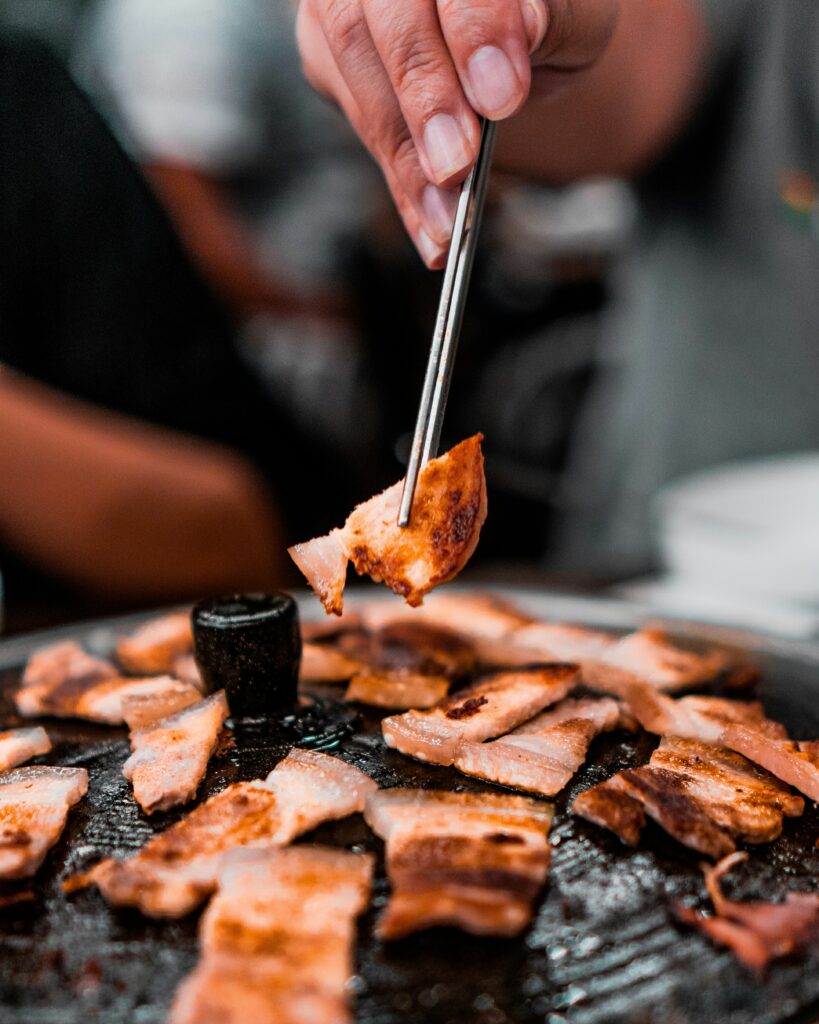
It was 1990. A Korean colleague invited me to a company dinner. I grabbed the tongs and started flipping my own meat. I poured my own soju. I stuck my chopsticks straight up in the rice.
The table went silent.
Nobody said anything directly — Koreans are too polite for that. But I could feel something was very wrong. It took me months to learn what I’d done.
35 years later, I’ve eaten Korean BBQ hundreds of times. I’ve hosted foreign visitors, attended company dinners, celebrated birthdays at gogigui restaurants across Seoul.
Here’s everything I wish someone had told me that first night.
Korean BBQ is more than just grilling meat.
It’s a social experience with its own rules and customs.
Don’t worry — Koreans don’t expect tourists to know everything. But knowing these basics will help you enjoy it more (and impress your Korean friends).
Korean BBQ (고기집, gogijip) is a style of dining where you grill meat yourself at your table.
The grill is built into the table. Raw meat is served, and you cook it right there.
It’s interactive, social, and absolutely delicious.
Why I fell in love with Korean BBQ:
It’s not just about the food — it’s the experience.
In Western restaurants, everyone orders their own dish. You eat in your own little bubble. Korean BBQ is the opposite. Everyone shares. Everyone participates. You’re cooking together, eating together, drinking together.
My Korean father-in-law once told me: “고기를 함께 굽는 건 마음을 나누는 것이다” — “Grilling meat together is sharing hearts.”
After all these years, I think he’s right. Some of my best friendships were built over a hot grill and too much soju.
How It Works
Step 1: Choose Your Restaurant
Types of Korean BBQ:
Type
Korean
What You’ll Eat
Pork BBQ
삼겹살집
Pork belly, pork neck
Beef BBQ
소고기집
Beef cuts, hanwoo (Korean beef)
Chicken BBQ
닭갈비집
Spicy chicken on grill
All-in-one
고기뷔페
Buffet-style BBQ
Step 2: Order Meat
Meat is ordered by servings (인분, inbun).
1인분 (il-inbun) = 1 serving (120-200g)
2인분 (i-inbun) = 2 servings
Important: Most restaurants require minimum 2 servings. Order 2인분 or more, even if you’re alone.
Step 3: Grill the Meat
Staff often starts the first batch for you. After that, you grill it yourself.
Step 4: Eat with Wraps and Sides
Wrap meat in lettuce with rice, garlic, and sauces. Eat with unlimited free side dishes (banchan).
Step 5: Add Rice or Noodles
End with fried rice (볶음밥) on the grill, or cold noodles (냉면).
Popular Meat Cuts
Pork (돼지고기)
Korean
English
Description
삼겹살
Samgyeopsal
Pork belly (most popular)
목살
Moksal
Pork neck (leaner, tender)
항정살
Hangjeongsal
Pork jowl (fatty, flavorful)
갈매기살
Galmaeggisal
Skirt meat (chewy)
Recommendation: Start with samgyeopsal (pork belly). It’s the classic Korean BBQ experience.
Beef (소고기)
Korean
English
Description
소갈비
Sogalbi
Beef short ribs
차돌박이
Chadolbagi
Beef brisket (thin, fast cooking)
등심
Deungsim
Sirloin
안심
Ansim
Tenderloin
한우
Hanwoo
Premium Korean beef (expensive!)
Recommendation: Chadolbagi cooks fast and tastes amazing. Try hanwoo if you want to splurge.
My personal ordering strategy:
After hundreds of Korean BBQ meals, here’s what I order:
For 2 people:
삼겹살 (samgyeopsal) 2 servings
목살 (moksal) 1 serving
된장찌개 (doenjang jjigae) 1 to share
For 4 people:
삼겹살 3 servings
갈비 (galbi) 2 servings
냉면 (naengmyeon) 2 to share at the end
My go-to restaurant:
There’s a place in Mapo-gu called 황소막창 that I’ve been going to for 15 years. The owner knows my order by heart. The meat quality is consistent. The된장찌개 is perfect.
Not saying it’s the “best” in Seoul — every Korean has their own spot. But finding YOUR regular place is part of the Korean BBQ experience.
Tip for tourists:
If a restaurant is full of Korean office workers at 7 PM, it’s good. If it’s full of tourists, be cautious. Koreans know where to eat.
The Art of Wrapping (쌈)
This is how Koreans eat BBQ:
Basic Wrap Method
Take a lettuce leaf (상추)
Add a piece of cooked meat
Add a bit of rice
Add sliced garlic (optional)
Add ssamjang (spicy paste)
Wrap it up
Put the whole thing in your mouth!
Important: Eat the wrap in ONE BITE. Don’t take small bites — it’ll fall apart.
Wrap Combinations
Wrap
Good With
Lettuce (상추)
Everything
Perilla leaf (깻잎)
Pork belly
Pickled radish (무)
Beef
Grilled garlic
Everything
Side Dishes (Banchan)
Korean BBQ comes with many free side dishes:
Banchan
Description
김치
Kimchi (fermented cabbage)
상추
Lettuce for wrapping
깻잎
Perilla leaves
마늘
Sliced garlic (grill it!)
파절이
Green onion salad
쌈장
Spicy dipping paste
된장
Soybean paste
콩나물
Bean sprouts
All refills are FREE! Just ask: “반찬 더 주세요” (banchan deo juseyo)
BBQ Etiquette Rules
Rule 1: Don’t Flip Too Much
Let the meat cook properly before flipping.
Flip only once or twice
Don’t press down on the meat
Wait for proper color/sizzle
Over-flipping = dry meat = rookie mistake.
Rule 2: Use the Scissors
Korean BBQ often uses scissors to cut meat. This is normal! Cut large pieces into bite-sized pieces.
Scissors + tongs = your BBQ tools.
Rule 3: Oldest Person Eats First
In Korean culture, the oldest person at the table should take the first bite.
If you’re dining with Koreans, wait for the eldest. If you’re with friends, whoever’s hungriest goes first!
Rule 4: Don’t Waste Meat
Order what you can eat. Wasting food is frowned upon in Korea.
Start with 2인분 and order more if needed.
Rule 5: Pour Drinks for Others
Don’t pour your own drink (especially alcohol). Pour for others, and they’ll pour for you.
When someone older pours for you:
Hold your glass with two hands
Turn slightly to the side when drinking
Rule 6: Keep the Grill Clean
Move cooked meat to the side or to your plate. Don’t let meat burn while chatting!
Staff will change the grill if it gets too charred.
The mistake that still haunts me:
That first dinner in 1990? I grabbed the tongs because I wanted to be helpful.
In American culture, taking initiative is good. In Korean culture, I had just disrespected the senior person at the table. The tongs belong to the youngest or lowest-ranking person — it’s their job to serve others.
By grabbing them, I basically announced: “I don’t respect the hierarchy here.”
The rule I follow now:
Wait. Watch. If someone hands you the tongs, accept graciously. If not, let them handle it.
At casual dinners with friends, it’s more relaxed now. But at company dinners or with older Koreans? I still wait to be invited before I touch those tongs.
Grilling Tips from a Local
Tip 1: Grill the Garlic
Put raw garlic slices on the grill. Once golden, add to your wrap. Game changer.
Tip 2: Grill the Kimchi
Slightly grilled kimchi with pork belly is incredible. Try it.
Tip 3: Dip in Sesame Oil + Salt
Mix sesame oil (참기름) with salt (소금). Dip your meat. This is how Koreans eat beef.
Tip 4: Ask for Help
If you’re struggling, staff will often help grill. Just ask or look helpless — they’ll come over.
Tip 5: End with Fried Rice
Most BBQ places offer to make fried rice (볶음밥) on your grill with leftover meat and vegetables. Say “볶음밥 주세요” (bokkeumbap juseyo).
How I Learned to Make the Perfect Ssam
Making ssam (lettuce wrap) is an art. It took me years to perfect.
My beginner mistakes:
Stuffing too much meat — the wrap exploded everywhere
Forgetting the garlic — ssam without garlic is like pizza without cheese
Too much ssamjang — couldn’t taste the meat anymore
My current technique (after 30+ years):
One piece of lettuce (perilla leaf if available — game changer)
One piece of meat (not two, not three — one)
Thin slice of raw garlic (trust me)
Small smear of ssamjang
Optional: rice, kimchi, grilled garlic
Fold and eat in ONE BITE
The one-bite rule is important. Taking two bites looks awkward and ingredients fall out.
My Korean mother-in-law watched me make ssam last Chuseok. She nodded approvingly and said: “이제 한국 사람 다 됐네” — “Now you’ve become fully Korean.”
Best compliment I’ve ever received.
Drinks at Korean BBQ
BBQ and drinks go together in Korea.
Popular Choices
Drink
Korean
Description
Soju
소주
Korean vodka (goes with pork)
Beer
맥주
Any Korean beer
Somaek
소맥
Soju + beer mixed
Coke
콜라
For non-drinkers
Cider
사이다
Korean Sprite
Drinking Etiquette
Pour with two hands (respect)
Receive with two hands
Don’t pour your own drink
Turn away from elders when drinking
Drinking etiquette is important in Korea. Learn more cultural rules in our Korean Etiquette Guide.
The soju lesson I’ll never forget:
Second week in Korea. Dinner with my boss.
He poured me soju. I said thanks and drank it. Then I poured my own refill.
He didn’t say anything, but his expression changed. Later, a younger colleague quietly explained: “You never pour your own drink. It looks like no one cares about you enough to pour for you.”
Mind. Blown.
What I do now:
I keep an eye on everyone’s glass. When someone’s glass is empty, I pour for them. When my glass is empty, I wait. Someone always notices.
The beautiful thing? Once you understand this system, you realize it’s about taking care of each other. It’s not about rules — it’s about connection.
Pro tip: If your glass is empty and nobody’s pouring, hold it up slightly toward the most senior person. They’ll get the hint.
The head-turn that saved me:
Korean BBQ dinners often involve drinking with your boss or elders.
The rule: when drinking in front of someone senior, turn your head away as you drink. It shows respect — you’re not “facing” them while drinking.
I forgot this rule once at a work dinner with the company CEO. The moment the soju touched my lips, I made direct eye contact with him while drinking.
He laughed and said in English: “You must be American!”
I’ve never forgotten to turn my head since.
When you can skip this:
Close friends, casual dinners, people your age. Nobody expects it. But at formal dinners or with elders? Always turn.
Ordering Guide
Essential Phrases
English
Korean
Pronunciation
2 servings of pork belly
삼겹살 2인분
samgyeopsal i-inbun
2 servings of beef
소고기 2인분
sogogi i-inbun
More lettuce, please
상추 더 주세요
sangchu deo juseyo
More side dishes
반찬 더 주세요
banchan deo juseyo
Fried rice, please
볶음밥 주세요
bokkeumbap juseyo
1 soju, please
소주 하나요
soju hanayo
Change the grill, please
불판 갈아주세요
bulpan garajuseyo
How Much Does It Cost? (2026 Prices)
Type
Price Range (per serving)
Pork BBQ (삼겹살)
15,000-22,000 won
Beef BBQ (소고기)
20,000-35,000 won
Premium Hanwoo
40,000-80,000+ won
Chicken BBQ
15,000-20,000 won
Budget for 2 people:
Pork: 40,000-60,000 won
Beef: 60,000-100,000 won
With drinks: Add 15,000-30,000 won
Real costs from my recent visits:
Last month, I took two visiting friends to Korean BBQ. Here’s exactly what we paid:
Mid-range restaurant in Hongdae:
삼겹살 3인분 (3 servings): 42,000원
목살 2인분: 28,000원
소주 3병: 15,000원
음료수: 6,000원
Total for 3 people: 91,000원 (about 30,000원 each)
High-end restaurant in Gangnam:
한우 등심 (Hanwoo beef): 89,000원 per serving
We ordered 3 servings + sides
Total for 2 people: 340,000원
The Gangnam place was delicious, but honestly? The Hongdae restaurant was more fun. The atmosphere, the energy, the crowd — that’s what Korean BBQ is about.
My advice: Start with a 15,000-20,000원 per person place. You’ll have a great time without spending a fortune.
Finding BBQ Restaurants
Famous Chains
Name
Specialty
Price Level
새마을식당 (Saemaeul)
Pork belly
$$
고기굽는집
All meat
$$
황소고집
Beef
$$$
본가
Premium hanwoo
$$$$
Local Tip
Best BBQ is often at small, no-name places with smoke-stained walls and packed tables.
If it’s full of Koreans at 8 PM, it’s good.
Mistakes I’ve Seen Tourists Make
Mistake #1: Touching the Grill with Your Eating Chopsticks
The grill chopsticks and your eating chopsticks are different!
I’ve watched tourists grab meat straight from the grill with the same chopsticks they’re eating with. Some Koreans will overlook it, but it’s technically unsanitary.
Rule: Use the long metal chopsticks/tongs for grilling. Use your own chopsticks for eating.
Mistake #2: Refusing Soju Too Directly
A Korean host offers you soju. You say “No thanks, I don’t drink.”
Technically fine. But you’ve just made things awkward.
Better approach: Accept the first glass, take a tiny sip, then nurse it. Or say you’ll have beer instead. Complete refusal can feel like rejection of their hospitality.
After 35 years, I’ve learned: you can hold a soju glass all night without actually drinking much. Nobody really tracks how much you consume.
Mistake #3: Leaving Too Much Meat on the Bone
Koreans don’t waste meat. When eating galbi (ribs), we pick the bones clean.
I once watched an American friend leave half the meat on his galbi bones. My Korean colleague quietly picked up the bones and finished them. No judgment — but it was noticeable.
Tip: It’s completely acceptable to pick up the bone and bite the meat off directly. Not rude at all. Actually shows you’re enjoying the food.
Mistake #4: Blowing Your Nose at the Table
This isn’t BBQ-specific, but it comes up because — smoke, heat, spicy food.
In Western culture, blowing your nose at the table is normal. In Korea, it’s disgusting. Really disgusting.
If you need to blow your nose: Excuse yourself. Go to the bathroom. Come back.
I still accidentally do this sometimes after 35 years. My wife still gives me THE LOOK.
How much does Korean BBQ cost?
In my experience, budget 25,000-35,000원 per person for a satisfying meal with drinks.
Last week I spent 28,000원 and left completely stuffed. The week before, I spent 45,000원 at a nicer place — better meat, but honestly not twice as good.
For first-timers, I recommend mid-range restaurants. The experience is the same, and the meat quality is usually excellent.
Do I need to tip at Korean BBQ?
Never. This still amazes my American friends.
I’ve eaten at Korean BBQ restaurants where the service was incredible — constant attention, meat grilled perfectly, refills before I asked. The tip? Zero. They’d actually be confused if you tried.
Koreans show appreciation by becoming regulars. I’ve been going to the same restaurant for years. That loyalty means more than any tip.
Is Korean BBQ healthy?
Let’s be honest: it’s not a salad.
But compared to Western BBQ, it’s actually not bad. The meat is relatively lean (especially 목살), you eat tons of vegetables with ssam, and portions are controlled by the serving sizes.
My doctor told me Korean BBQ once a week is fine. Twice a week… maybe cut back on the soju.
I go about 2-3 times a month now. It’s my reward for eating healthy the rest of the time.
My solo Korean BBQ story:
For years, I thought eating Korean BBQ alone was impossible.
Then one lonely Tuesday, I found a place in Euljiro with a sign: “1인분 가능” (1-portion available). I sat down, nervous. Ordered one portion of 삼겹살.
The ajumma looked at me sadly and brought extra banchan. “혼자 왔어요?” (You came alone?) She practically adopted me for the evening.
The meat was cooked on a smaller grill. I grilled, I ate, I drank a beer. It was… actually peaceful.
Where to find solo-friendly BBQ:
Look for “1인분 가능” signs
백정 (Baekjeong) chain allows single servings
Many places near train stations cater to solo diners
It’s becoming more common as “혼밥” (honbap — eating alone) culture grows in Korea. Don’t be afraid to try it.
My Korean BBQ Routine
After 35 years of eating Korean BBQ, here’s my order:
삼겹살 2인분 (pork belly) to start
목살 1인분 (pork neck) next
소주 + 맥주 (soju + beer)
Grill garlic and kimchi on the side
볶음밥 (fried rice) to finish
Walk home happy
Final Thoughts
Korean BBQ isn’t just my favorite food — it’s my favorite Korean experience.
Some of my deepest friendships were formed over a smoky grill. My proposal to my wife? After Korean BBQ. Major business deals? Sealed over samgyeopsal. Even family arguments get resolved better with soju and meat.
The etiquette might seem complicated at first. The hierarchy, the pouring, the grilling — it’s a lot to remember.
But here’s what I’ve learned after 35 years: Koreans don’t expect perfection from foreigners. They notice when you TRY. When you turn your head to drink, when you pour for others, when you wait for elders to eat first — they see that.
And they appreciate it deeply.
So don’t stress about getting everything right. Just be respectful, be humble, and enjoy the experience.