Last updated: January 2026
Seoul subway in 1989 had 4 lines.
Four. That was it.
I watched them build Line 5, 6, 7, 8. The airport line. The Sinbundang Line. What started as a simple system became one of the best metro networks on Earth.
Now there are 23 lines. Over 700 stations. Air conditioning, WiFi, heated seats, platform screen doors.
And it costs less than $1.50 to go anywhere.
35 years of riding Seoul subway. Here’s everything I know.
Seoul’s subway is incredible.
Clean, cheap, on-time, everywhere.
Possibly the best metro system in the world.
Once you understand it,
you’ll never need taxis.
Here’s everything you need to know.
You’ll need a T-money card for the subway. Get one first — see our T-money Card Guide.
Seoul Subway Basics
The System
| Fact | Detail |
|---|---|
| Lines | 23 lines |
| Stations | 700+ |
| Daily riders | 7+ million |
| Hours | 5:30 AM – midnight |
| Fare | 1,500원 base |
The Lines
Main lines (numbered):
- Line 1: Dark blue (oldest, above ground)
- Line 2: Green (circle line, most useful)
- Line 3: Orange
- Line 4: Light blue
- Line 5: Purple
- Line 6: Brown
- Line 7: Olive
- Line 8: Pink
- Line 9: Gold
Plus: Airport Railroad (AREX), Bundang Line, Gyeongui Line, etc.
Most Useful Lines
| Line | Connects |
|---|---|
| Line 2 | Hongdae, Gangnam, Jamsil (circle) |
| Line 3 | Gyeongbokgung, Anguk |
| Line 4 | Myeongdong, Seoul Station |
| AREX | Incheon Airport to Seoul |
What I appreciate after 35 years:
| Feature | Seoul Subway | My US Experience |
|---|---|---|
| Cleanliness | Spotless | Not great |
| Safety | Extremely safe | Varies |
| Cost | 1,400-1,500원 | $3-5 |
| Frequency | 3-5 min peak | 10-20 min |
| WiFi | Free, everywhere | Rare |
| Air conditioning | Every car | Sometimes |
The first time it impressed me:
- Summer. Rush hour. Packed train.
I noticed the air conditioning was perfect. The floors were clean. Nobody was pushing or yelling.
I’d ridden the New York subway. The contrast was… significant.
What still impresses me:
The precision. When the app says 3 minutes, it’s 3 minutes. Not 5-7. Not “delayed.” Three minutes.
After 35 years, I still find this remarkable.
How I navigate now vs. then:
| 1989 | Now |
|---|---|
| Paper maps | Naver Map / Kakao Metro |
| Asking strangers | Phone tells me everything |
| Guessing exits | App shows exact exit numbers |
| Missing transfers | Transfer alerts |
The app that changed everything:
Kakao Metro. Shows real-time arrivals, which car to board for fastest transfer, which exit is closest to your destination.
Before smartphones, I memorized transfer routes. Knew which car to ride for efficient exits. Old school survival.
Now I just follow the app. Technology win.
My tip for tourists:
Download Kakao Metro before your trip. Select English. Screenshot your routes.
Even if you have no data, the screenshots will guide you.
Or get an eSIM and use it live. Even better.
Getting a T-money Card
What is T-money?
Rechargeable transit card.
Works on subway, bus, taxi.
Essential for any Seoul visit.
Where to Buy
- Convenience stores (CU, GS25, 7-Eleven)
- Subway station kiosks
- Incheon Airport
Cost
- Card itself: 2,500-5,000원
- Then add money for trips
How to Recharge
- Go to convenience store
- Say: “충전해주세요” (chungjeon haejuseyo)
- Say amount (만 원 = 10,000원)
- Pay cash or card
- Done
Or use subway ticket machines.
Subway Fares
Base Fare
| Type | Distance | Price |
|---|---|---|
| Base fare | 0-10km | 1,500원 |
| Additional | Every 5km | +100원 |
Most trips in Seoul: 1,500-1,800원.
T-money Discount
Using T-money is cheaper than single tickets.
- T-money: 1,500원
- Single ticket: 1,600원 (includes 500원 deposit)
Free Transfers
Transfer between subway and bus:
- Free within 30 minutes
- Tap T-money each time
How to Ride
Step 1: Find Your Station
Use Naver Map or Kakao Metro.
Search destination in English.
App shows which line and direction.
Step 2: Enter Station
Find entrance with number/letter.
Go down stairs or escalator.
Look for ticket gates.
Step 3: Tap In
Hold T-money to blue pad.
Gate opens.
Walk through.
Step 4: Find Platform
Look for:
- Line number (and color)
- Direction (usually shows final station name)
- Platform number (1 or 2)
Signs are in Korean AND English.
Step 5: Board Train
Trains come every 2-5 minutes.
Stand in line markings on platform.
Let passengers exit first.
Step on and find spot.
Step 6: Ride
Announcements in Korean, English, Chinese, Japanese.
Watch for your station.
Digital displays show next stops.
Step 7: Exit
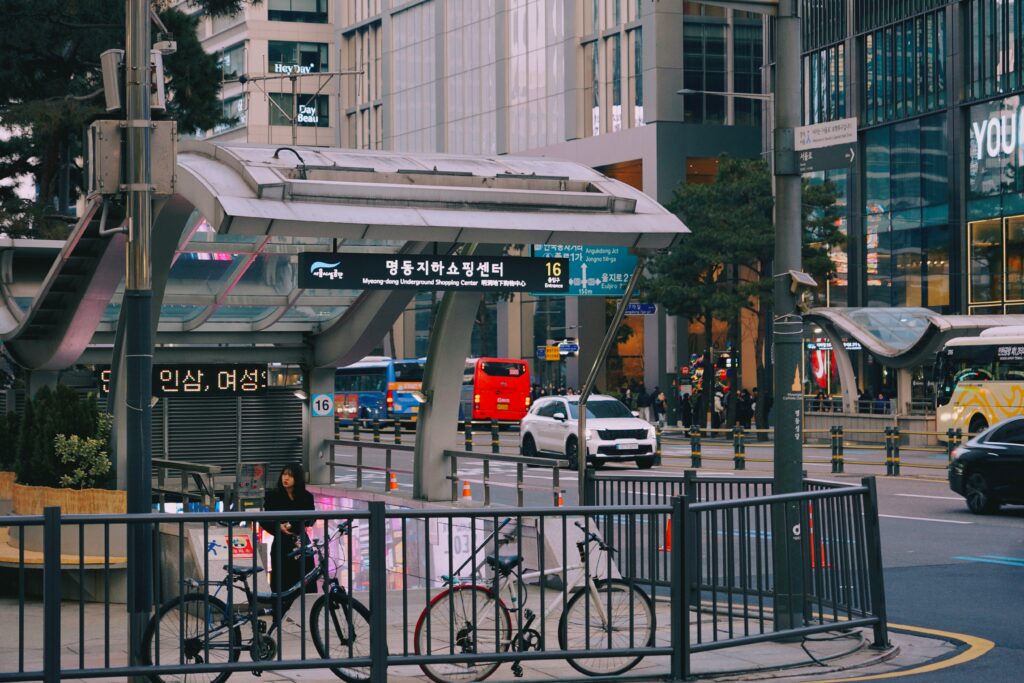
Get off at your station.
Follow exit signs (numbered exits).
Tap out at gates.
The rule that confuses foreigners:
Priority seats are NOT just “preferred” seating. They’re almost sacred.
I’ve seen empty priority seats while people stand nearby. Nobody sits. Even when the train is packed.
My embarrassing moment:
Early 1990s. Tired after work. Empty priority seat. Sat down.
An elderly woman got on. Looked at me. Looked at the seat. Her expression… I still remember it.
I jumped up immediately. Apologized profusely. She said nothing. Just sat down.
The silent judgment of an entire train car. Educational.
The unwritten rules:
| Situation | What to Do |
|---|---|
| Priority seats empty | Don’t sit (unless train is empty) |
| You’re elderly/pregnant/disabled | You can sit |
| You accidentally sit | Move immediately when someone boards |
| Regular seats full | Stand, don’t take priority seats |
Koreans take this seriously. Respect it.
Navigating Transfers
Transfer Stations
Many stations connect multiple lines.
Transfers are free (don’t exit gates).
Biggest transfer stations:
- Seoul Station (Line 1, 4, AREX)
- Jongno 3-ga (Line 1, 3, 5)
- Dongdaemun History & Culture Park (Line 2, 4, 5)
- Express Bus Terminal (Line 3, 7, 9)
- Wangsimni (Line 2, 5, Bundang)
How to Transfer
- Get off train
- Follow signs for your next line
- Walk through corridors (can be long!)
- Find new platform
- Continue journey
Important: Don’t exit the gates!
Stay inside for free transfer.
Long Transfers
Some transfers are 5-10 minute walks.
Express Bus Terminal = famously long.
Budget extra time.
Subway Etiquette
Priority Seats
Never sit in priority seats.
Pink/marked seats are for:
- Elderly
- Pregnant women
- Disabled persons
- People with infants
Even if empty, locals avoid them.
You should too.
Quiet Car
Some trains have quiet cars.
Marked with special signs.
No phone calls, quiet talking.
General Rules
| Do | Don’t |
|---|---|
| Stand right, walk left (escalators) | Block escalators |
| Give up seat for elderly | Sit in priority seats |
| Use headphones | Play music out loud |
| Keep bags close | Take up multiple seats |
| Let people exit first | Rush into train |
| Keep voice down | Have loud phone calls |
Eating/Drinking
- Water: Usually OK
- Coffee: OK, but be careful
- Food: Technically not allowed
- Alcohol: Definitely not
Useful Features
Free WiFi
All stations and trains have WiFi.
- Network: “Free WiFi Korea” or similar
- Speed: Decent for messaging
- Connection: May need to reconnect
Phone Charging
Some newer trains have USB ports.
Look near seats or windows.
Station Facilities
Most stations have:
- Convenience stores
- Public toilets (free)
- ATMs
- Lockers (coin/card)
- Information desk
Accessibility
- All stations have elevators
- Tactile floor paths
- Audio announcements
- Staff can assist
Best Apps for Subway
Kakao Metro (카카오지하철)
Best for:
- Real-time arrival info
- Which car to board for transfers
- Exit information
Naver Map
Best for:
- Overall navigation
- Subway + walking combined
- English interface
Seoul Metro App
Official app.
Good but Kakao Metro usually better.
Download Kakao Metro before your trip. Our Best Korean Apps for Tourists guide covers this and other essential apps.
Tips & Tricks
Which Car to Board
Apps tell you optimal car for transfers.
Saves 2-5 minutes per transfer.
Very useful for tight connections.
Rush Hour
| Time | Level |
|---|---|
| 7-9 AM | Packed |
| 9-11 AM | Comfortable |
| 11 AM – 5 PM | Easy |
| 5-8 PM | Packed |
| 8-10 PM | Comfortable |
Avoid rush hour if possible.
Especially Line 2.
Rush hour reality:
| Time | Level | My Experience |
|---|---|---|
| 7:30-9:00 AM | Extreme | Bodies pressed together |
| 9:00-10:00 AM | Heavy | Crowded but manageable |
| 5:00-6:30 PM | Extreme | Same as morning |
| 6:30-8:00 PM | Heavy | Still crowded |
What extreme looks like:
Line 2 at Gangnam Station, 8:30 AM.
You don’t walk onto the train. You’re pushed by the crowd. Doors close against bodies. Personal space doesn’t exist.
I did this commute for years. You learn to hold your bag tight, position yourself near doors if getting off soon, and just… accept it.
How I avoid it now:
Working from home when possible. When not possible, I leave early (before 7 AM) or late (after 9:30 AM).
The difference between 8 AM and 9:30 AM is night and day.
Tourist advice:
If you’re sightseeing, there’s no reason to ride rush hour. Start your day at 10 AM. End by 4:30 PM. You’ll have a much better experience.
Last Train
Subway closes around midnight.
Last trains vary by line/station.
Check apps for exact times.
After midnight: Bus, taxi, or walk.
Finding Exits
Each station has numbered exits.
Example: “Exit 3” = specific street corner.
Naver Map tells you best exit.
Saves walking above ground.
Lockers
Available at most stations.
Sizes: Small (1,000원), Medium (2,000원), Large (3,000원)
4-hour blocks usually.
Cash or T-money.
Common Mistakes
Mistake 1: Wrong Direction
Lines go two directions.
Check the final destination name.
“Towards Sindorim” vs “Towards Jamsil”
If wrong, just get off and switch sides.
Mistake 2: Exiting for Transfer
Stay inside gates for transfers.
Exiting = paying again.
Mistake 3: Priority Seats
Just don’t sit there.
Even if empty.
Koreans will judge (silently).
Mistake 4: Rush Hour Travel
Avoid 8 AM and 6 PM.
Seriously, it’s intense.
Mistake 5: Insufficient Balance
If T-money runs low:
- Gate won’t open
- Recharge at machine nearby
- Then tap out
Keep at least 5,000원 loaded.
Beyond Seoul
KTX (High-Speed Rail)
For longer distances:
- Busan: 2.5 hours
- Gyeongju: 2 hours
- Jeonju: 1.5 hours
Book via Korail Talk app.
Seoul Station or Yongsan Station.
Other Cities
Other Korean cities have subways:
- Busan (5 lines)
- Daegu (3 lines)
- Gwangju (1 line)
- Daejeon (1 line)
Same T-money card works!
Subway Vocabulary
| English | Korean | Pronunciation |
|---|---|---|
| Subway | 지하철 | jihacheol |
| Station | 역 | yeok |
| Line | 호선 | hoseon |
| Transfer | 환승 | hwanseung |
| Exit | 출구 | chulgu |
| Platform | 승강장 | seunggangjang |
| This stop | 이번 역 | ibeon yeok |
| Next stop | 다음 역 | daeum yeok |
Sample Journey
Myeongdong to Hongdae
- Start: Myeongdong Station
- Board: Line 4 (toward Danggogae)
- Ride: 2 stops to Chungmuro
- Transfer: Line 3 (toward Daehwa)
- Ride: 4 stops to Gyeongbokgung
- Transfer: Walk to Line 3…
Wait, easier route:
- Myeongdong Station: Line 4
- Ride to Seoul Station
- Transfer: Line 1
- Ride to Sindorim
- Transfer: Line 2
- Ride to Hongdae
Actually, just use Naver Map.
It finds the best route.
Final Thoughts
23 lines. 700+ stations. 7 million daily riders.
And it just works.
I’ve ridden subways around the world. Tokyo, New York, London, Paris. Seoul is the best combination of clean, safe, cheap, and efficient.
The system grew with the city. I remember when Line 9 opened — suddenly Yeouido was accessible. When the airport line connected — no more bus anxiety.
35 years of watching this network expand and improve. It never stopped getting better.
Buy a T-money card. Download Kakao Metro. Trust the system.
It’ll get you anywhere.
— Ted K
Subway etiquette matters in Korea. Learn more cultural rules in our Korean Etiquette Guide.
Image Credits: Photos sourced from Unsplash. By using this site, you agree to our Privacy Policy and Disclaimer.